
Why institutional quality matters for regional R&D in Southern Europe

What explains regional differences in research and development expenditure? Juan A. Román-Aso, Fernando Coca Villalba, and Irene Bosch Frigola examine regions across Southern Europe, finding that institutional quality, particularly the impartiality of public administration, is positively associated with R&D spending. This relationship is strongest in less affluent regions and is primarily driven by Spain and Portugal. Their findings suggest that fair and transparent governance could play an important role in narrowing regional research and innovation disparities.
Investing in research and development (R&D) is essential, but money alone doesn't guarantee success. Without the right environment, R&D funding often gets lost in administrative friction or inefficient allocation. While there is a clear consensus on the need to foster R&D, what is less obvious are the key conditions that determine its success. Our study explores this dynamic, showing that institutional quality is positively associated with R&D expenditure, alongside the essential roles played by per capita income and infrastructure density.
We opted to study these hypotheses at the regional level, allowing us to analyse how subnational territorial disparities affect R&D expenditure. Regional authorities play a dual role here: they act both as direct funders of R&D and as strategic managers of those resources.
Geographically, the study focuses on Southern Europe, where regions share similar levels of income and socioeconomic development. They also exhibit common structural features, such as high public debt, service-oriented economies, and a high degree of decentralisation (especially in countries like Spain). Yet despite these similarities, Southern regions exhibit striking differences in the quality of their subnational institutions. As a result, businesses across different regions face uneven institutional transaction costs, and the availability and management of public funds vary substantially from one territory to another. The chart below illustrates the shift in R&D expenditure for the analyzed regions between 2010 and 2021.
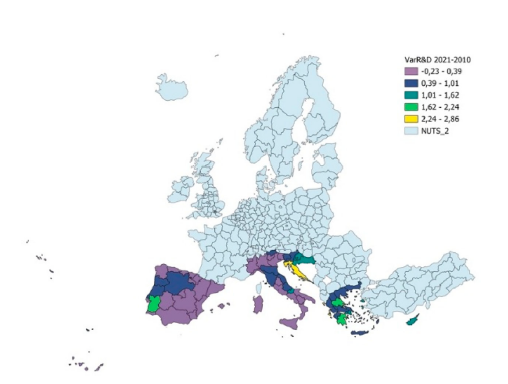
Our primary hypotheses suggest that higher institutional quality, greater per capita income, and superior infrastructure all drive regional R&D activity. These assumptions build on previous research, such as studies by Eric C. Wang or Ashraful Alam, Moshfique Uddin, and Hassan Yazdifar. We also incorporated and analysed additional variables related to regional human and technological capital.
One of the most debated aspects of this research is how to measure regional institutional quality. To address this, we rely on the European Quality of Government Index (EQI), developed by Charron, Dijkstra, and Lapuente at the Quality of Government Institute at the University of Gothenburg. The index captures citizen perceptions across three core pillars: impartiality, control of corruption, and the quality of public services. It is therefore built around these three components. The remaining variables used in our study are sourced from the Eurostat database. Methodologically, we began with standard panel data models combining different regions over time. We then turned to spatial econometric models to capture spillover effects and interregional interactions across borders.
Our results point to a positive link between institutional quality and R&D expenditure, with impartiality standing out as the single most critical driver. This offers a clear takeaway: when public authorities allocate research funds or define strategic priorities, citizen perception of fair and impartial governance is essential to building trust and incentivizing expenditure. Meanwhile, regional per capita income, human capital, and digital readiness show significant positive links with R&D expenditure. In contrast, variables related to physical infrastructure and air and maritime transport yield inconsistent result.
In spatial models, these results reveal important nuances: institutional quality is directly linked to public R&D expenditure, but its impact on private business expenditure acts as a positive spillover across borders. This suggests that in regions with strong institutions, companies tend to operate beyond their local territory—building networks and partnering with key players in neighbouring regions. Country-level heterogeneity analysis shows that the link with Quality of Government (QoG) varies geographically—it is predominantly driven by Spanish and Portuguese regions.
Another particularly compelling finding centres on the interaction between per capita income and institutional quality: evidence suggests that the positive link between Quality of Government (QoG) and R&D weakens at higher income levels. Consequently, institutional improvements in less-developed regions yield larger gains in R&D expenditure than in wealthier areas. This result aligns closely with the concept of "institutional traps" outlined by Andrés Rodríguez-Pose and Roberto Ganau—persistent social and informal norms that hinder economic progress.
These findings carry important policy implications. Southern European economies have traditionally been characterized by low R&D intensity, which often manifests in persistent challenges such as low productivity and unemployment. Closing this gap and transitioning toward a knowledge-based economy is therefore closely tied to strategies focused on improving the impartiality of regional public administrations.
However, this link is not uniform and is primarily observed across Spanish and Portuguese regions. In any case, regional authorities should clearly implement measures that promote transparency, regulate conflicts of interest, and guarantee impartial treatment to strengthen institutional trust. That said, these institutional improvements may not translate evenly across all national contexts, and their overall impact may vary.
---
Juan A. Román-Aso is a Lecturer and researcher at University of Zaragoza. His research is rooted in applied political economy, examining how institutional and political determinants shape socioeconomic and environmental outcomes.
Fernando Coca Villalba, PhD is a Lecturer and researcher at Universidad San Jorge (Spain). His research focuses on evaluating the impact of public policies, inequality, entrepreneurship and health economics.
Irene Bosch Frigola, PhD is Lecturer and researcher at Universitat de Valencia (Spain). Her research focuses on health economics, poverty and inequality, and the evaluation of technology, policy and innovation in entrepreneurship, as well as the impact of public policies.
---
Note: this post reflects the views of the authors and not those of Regional & Federal Studies, the Centre on Constitutional Change, or the University of Edinburgh.
Image credit: the Alhambra, Granada, by Jebulon via Wikimedia Commons
