
Do regions cooperate during crises? Analysing regional behaviour during the pandemic in Italy
Summarising her article in Regional & Federal Studies, Gaia Matilde Ripamonti explores the behaviour of regions in informal intergovernmental relations within the Italian decentralised system. In particular, her research focuses on the case of Italian regions during the pandemic, a crisis that required a tight cooperation between different levels of governance. She finds that, while regional behaviour in horizontal relations changed according to the interest at stake, regions were always conflictual towards the central government.
The COVID-19 pandemic had been a critical event that put governments worldwide under stress. During the period from 2020 to 2022, governments around the world were confronted with an unexpected and unprecedented health crisis that threatened the survival of people, the resilience of the global economy, and the endurance of society as a whole.
In February 2020, Italy became the first country in the European Union to be severely hit by the crisis. In times of severe uncertainty and urgency, the Italian national government soon decided to implement stringent restrictions to limit the spread of the virus. Freedom of movement was severely restricted, mass-testing was implemented, and healthcare services had to be reorganised quickly and significantly to cope with the health emergency. Coordination and cooperation between the different levels of government are crucial during periods of significant problem pressure and unpredictability. This was also the case in Italy, where actors had to design and implement key health and economic policies in a very short space of time at the beginning of the pandemic.
In this context, the role of the Italian regions was crucial, as they are not only important political actors within the political system, but are also primarily responsible for organising and providing healthcare services, which were pivotal in dealing with the pandemic. Therefore, their political and service-providing roles were both essential, especially during the first part of the crisis. However, over time, the characteristics of the pandemic changed. In its second year, it transformed from a health crisis into primarily a socio-economic one, when the vaccination campaign started to have an effect, calming the mortality rate and the spread of the virus, and bringing to light all the economic consequences of the health crisis. In Italy, this shift was also marked by the transition from a political government led by Giuseppe Conte to a (partially) technical one led by Mario Draghi, the former president of the European Central Bank, whose task was to negotiate and define the contents of the Italian National Recovery and Resilience Plan.
Notably, despite their significant involvement in Italy’s decentralised system, the involvement and impact of regions is generally understudied. Indeed, it is true that processes of centralisation are more common during times of crisis, as was the case in Italy, especially under the Draghi government. However, at least some regions saw in the pandemic an opportunity to increase to revive the issue of regional self-government. Furthermore, the ability of subnational governments to influence national decision-making should not be underestimated since they have sufficient power to affect the outcome of decisions. They can do this formally by leveraging the (weak) institutional intergovernmental bodies in which they are involved for national policymaking. Or they can also influence outcomes informally, for example by applying political pressure to the national government or cooperating in defining and implementing policies outside formal institutions. This means that regional behaviour towards other actors, whether the national government or other regions, is also important in understanding intergovernmental relations within a country.
To fully grasp this latter aspect, an investigation into regional behaviour is required, focusing more on the informal than the formal aspect of intergovernmental relations. While formal relations are difficult but still possible to investigate despite the limited availability of sources and documents, informal relations are even more challenging as they rarely leave a trace, especially when the actor in question is not the national government. One possible solution is to rely on indirect sources of information. In this sense, newspapers can be a valuable resource for analysing and categorising actors’ behaviour – particularly with regards to the pandemic period, when meetings and press conferences were limited.
By decoding the information provided by over 300 newspaper articles collected during the state of emergency in Italy (2020–2022), it was possible to identify two different types of regional behaviour: a cooperative behaviour, which included a predisposition towards dialogue, cooperation, coordination and acceptance of others’ work and authority; and a conflictual behaviour, which included both expressed and hidden strategies of blame, such as complaints, contestation of decisions and critiques of others’ decisions or work, as well as declarations of missed expectations.
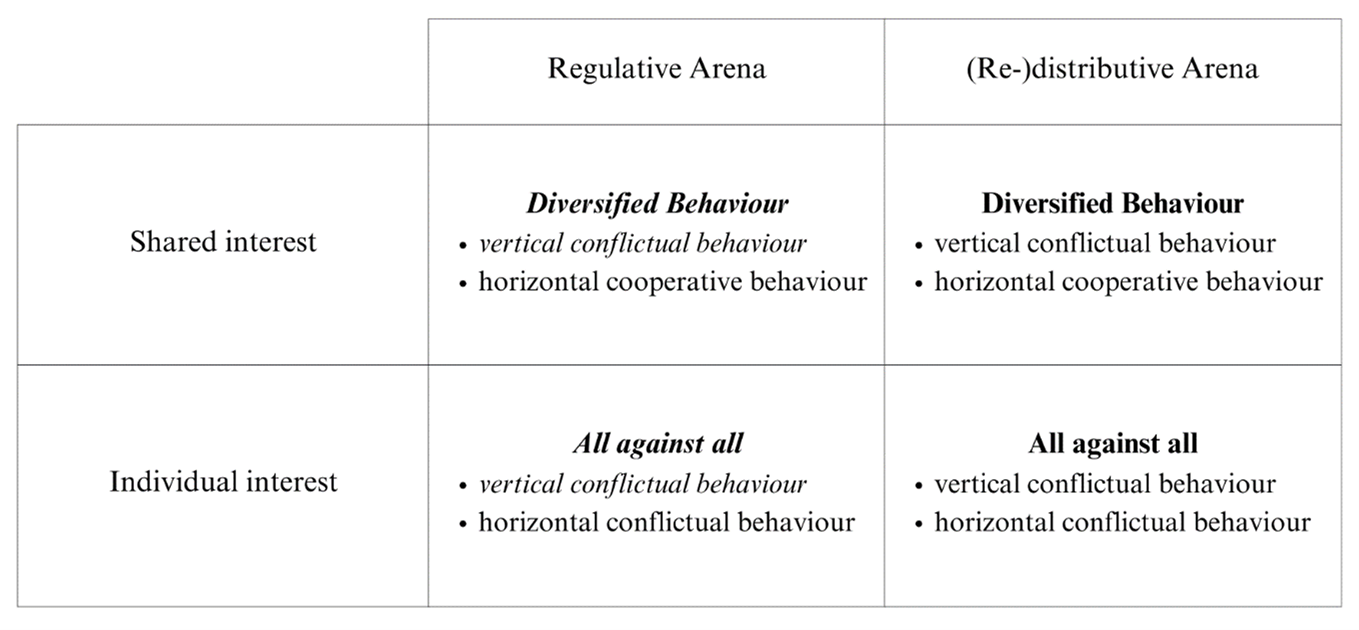
During the pandemic, the Italian regions were conflictual when individual interests were at stake in horizontal relations, i.e. relations between regions. When confronted with other regions, either during discussions on rules and regulations or concerning the (re-)distribution of resources, they adopted a behaviour that primarily defended their personal territorial interests. However, when regions shared a common interest, that is an interest specific to the regions as such and not to the individual territories, they cooperated with each other in both the regulatory and (re-)distributive arenas. This was not the case in vertical relations, where regions were always conflictual towards the central government.
Three situations arose:
- A diversified behaviour emerged in the case of regional shared interests: regions cooperated with each other and were conflictual with the central government in both the regulatory and redistributive arenas.
- An all against all behaviour emerged in the case of individual interests: regions were conflictual towards both the national and subnational governments in both the regulatory and redistributive arenas.
- No fully cooperative behaviour emerged: when decisions on rules and regulations had to be made, a more cooperative approach was expected even towards the central government, especially given the urgency and risks of the pandemic; however, such an outcome did not occur.
In a context in which technical committees and experts were at the heart of decision-making, while regions were generally marginalised from policymaking, subnational governments resorted to different types of strategies in intergovernmental relations. Ultimately, the type of interest at stake did influence regional behaviour in horizontal relations. When a shared interest was discussed or involved in a policymaking process, regions were able to cooperate with each other. Indeed, it was somewhat unexpected that neither the type of interest nor the type of arena had an impact on the behaviour towards the central government: in those instances, subnational governments were always conflictual.
As little is known about the informal aspects of intergovernmental relations, these findings offer an important starting point for addressing a largely overlooked dimension of multilevel governance, especially in Italy. The pandemic provided a valuable testing ground, revealing dynamics that would likely have remained less visible under ordinary circumstances. Yet, this is only a first step. Further research is needed to establish whether these patterns persist beyond emergency contexts, how they evolve over time and their influence on formal decision-making processes.
This is a summary of the article From full cooperation to all against all? Italian regions in intergovernmental relations during the pandemic from Regional and Federal Studies.
Gaia Matilde Ripamonti is a postdoctoral researcher in the Department of Political and Social Sciences at the University of Trieste. Her research largely focuses on intergovernmental relations, elections and public policy in decentralised countries, particularly in Italy. She has published on the policymaking during the pandemic, regionalism, regional healthcare systems and gender policy.
Note: This article represents the views of the authors, and not those of Regional & Federal Studies, the Centre on Constitutional Change, or the University of Edinburgh.
Image: sede dell'ente Regione Emilia-Romagna a Bologna, CC BY-SA 3.0; Baldo051via Wikipedia
