Diversity fuels cabinet conflict – and decentralisation can make it worse
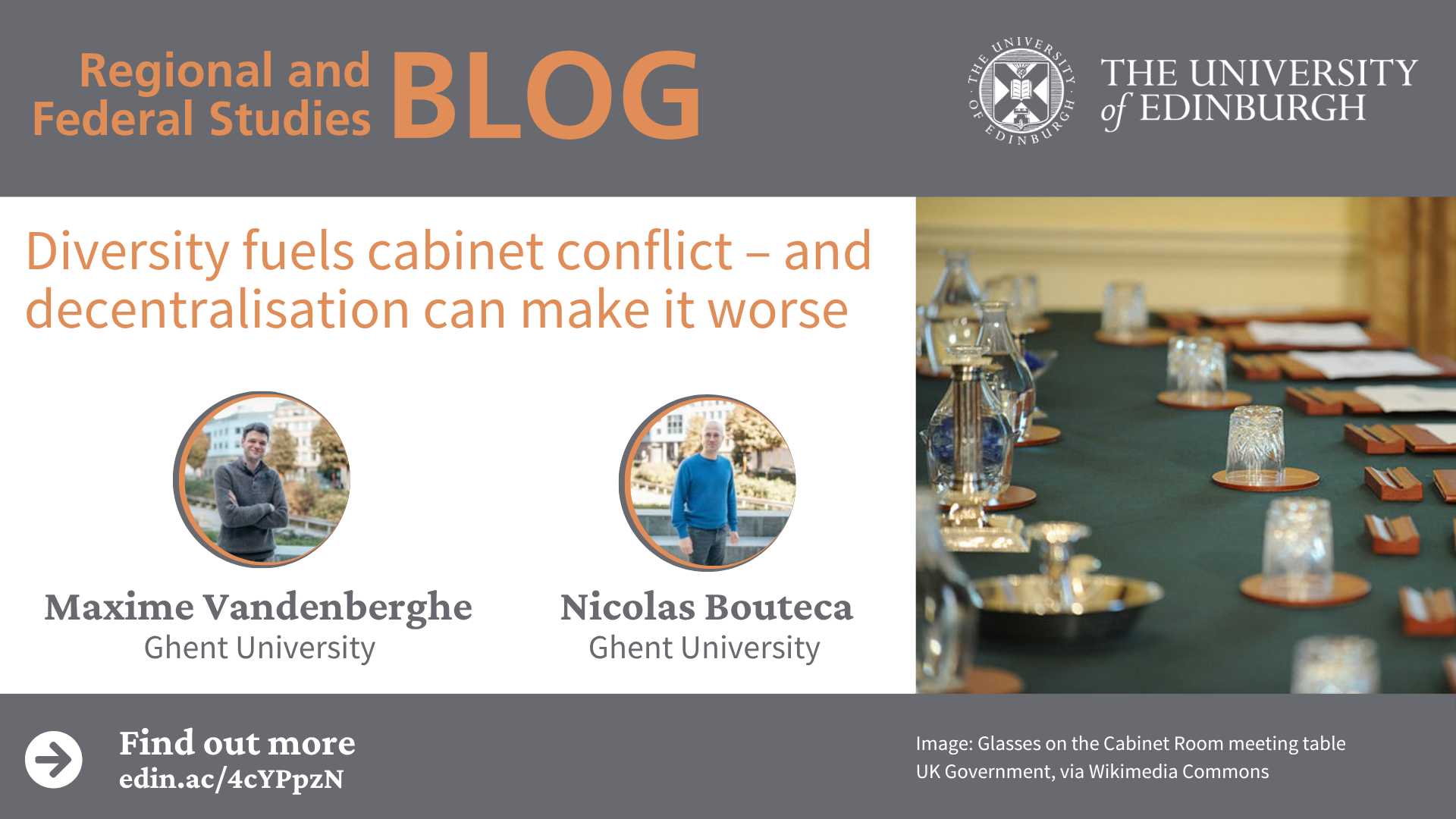
Summarising a recent article in Regional & Federal Studies, this blogpost by Maxime Vandenberghe and Nicolas Bouteca argue that ethno-territorial diversity creates a visible “heterogeneity cost” in everyday government, increasing routine conflicts between coalition partners as well as more serious cabinet disputes. Drawing on the CABCON dataset of 807 cabinet conflicts across eight European countries, it shows that diversity matters not only in moments of crisis, but also in the day-to-day politics of governing. The post also offers a nuanced view of decentralisation: while it can ease some tensions by shifting decisions closer to affected groups, in highly diverse countries it may intensify ethno-territorial conflict by encouraging new claims and reopening contested questions.
Governing ethno-territorially divided societies is often described as inherently difficult. Where different linguistic, ethnic, or territorial groups coexist, political tensions are thought to be more likely. This relates to what Alesina and Spolaore call the “heterogeneity cost”. The idea that internal diversity burdens countries and makes them harder to govern is frequently invoked by regionalist movements in places such as Catalonia, Flanders, and Northern Italy.
Earlier studies already exposed the relation between diversity and economic outcomes or extreme forms of conflict, citing casualty figures, riot frequencies, or the collapse of states as such. Much less is known about how diversity shapes the everyday functioning of governments. Yet it is precisely these routine conflicts that shape governability and policy-making.
Is the heterogeneity cost also visible in ‘mundane’ politics? Are ethno-territorially diverse countries ‘harder to govern’, in that governments in such countries face more frequent tensions? Looking at routine dynamics in cabinets reveals a straightforward pattern: the cost is clearly visible.
This conclusion builds on our newly launched dataset of 807 cabinet conflicts across roughly 100 governments in eight European countries between 1991 and 2020. Currently, the CABCON dataset covers Austria, Belgium, Germany, Italy, Ireland, the Netherlands, Slovakia, and Sweden. By providing a unique view of three decades of executive politics, we hope that CABCON can open many doors in the growing study of conflict and cooperation in cabinets.
Concerning the heterogeneity cost, the picture is clear: higher levels of ethno-territorial diversity are associated with more frequent conflicts between coalition partners. These range from low-level quarrels with little relevance to serious confrontations and spectacular cabinet resignations. The pattern holds at the yearly and country level, across different conflict measures, and after accounting for political, institutional, and economic factors. Ethno-territorial diversity does not just matter to make sense of major crises and violent disruption – it also relates to more frequent political conflict in central governments.
Diversity and everyday political conflict
How can we explain this cost? Part of the explanation seems to lie in the types of issues that arise in diverse societies. Debates over language, identity, minority rights, or territorial autonomy are notoriously difficult to resolve, highly emotional, and prone to escalation. They are political landmines. At the same time, diversity creates divisions not only between groups but also within them (e.g. on the preferred strategy), multiplying potential lines of conflict.
Even policy areas that are not ethno-territorial sensu stricto can be contested along these lines. Whether it’s about economic reforms, environmental policy, or international negotiations: perceived or actual differences between the interests and preferences of sub-states can turn any debate into an ethno-territorial box match. As a result, diversity increases both the number of contentious issues and the difficulty of managing them. Importantly, this is not per se a matter of personal affairs or agitation. It is not necessarily the cooperation between ministers of different groups that is difficult (who governs), but rather the issues they face (what is governed). For example, Belgium is the only country in our analysis with a constitutionally required inter-group parity amongst ministers. Yet, even amongst the diverse states, it is not the most conflict-ridden country. The problems, it seems, relate to policy and polities – not people.
Decentralisation as a double-edged sword
Decentralisation is often seen as a way to manage diversity and resolve conflict. By shifting decision-making to the sub-state level, it allows contentious issues to be handled closer to the groups concerned, reducing pressure on central governments and separating the fighting dogs.
While the analyses of cabinet conflicts provide some evidence supporting this view, they also highlight that decentralisation is no simple remedy. Its effects depend on context.
On the one hand, higher levels of decentralisation are indeed associated with fewer cabinet conflicts overall, suggesting that autonomy can help ease everyday tensions in central cabinets too.
However, this is only part of the story. In highly diverse countries like Belgium, decentralisation intensifies the negative relation between diversity and conflict. It increases the heterogeneity cost. Rather than resolving disputes, decentralisation can thus provide fertile ground for increased claims, challenges to existing arrangements, and the reopening of contested questions.
This effect, which echoes the so-called paradox of federalism, is not observed in less diverse countries and only applies to ethno-territorial conflicts. It does not seem to contaminate other policy domains.
Explosive by nature, escalation by design
The overall conclusion is clear yet nuanced. Ethno-territorial diversity relates to higher levels of cabinet conflict, confirming the idea of a “heterogeneity cost” in everyday politics. Some countries, it seems, are simply more ‘explosive’ by nature. Institutional design matters, but plays an ambiguous role. While decentralisation can reduce overall tensions, it can also intensify specific conflicts where divisions are deepest. It can cause the volcano to erupt.
These nuanced conclusions help explain why scholars and politicians continue to debate whether institutional reforms are solutions or rather sources of new tensions. Effects are fuzzy, time and context-dependent.
Handle with care
Hence, just like diversity itself, these comparative finding must be handled with care. There is no one-size-fits-all fix.
For instance, earlier research on Belgium, for example, shows that decentralisation contributed to long-term pacification: a declining number of cabinet conflicts that relates to the country’s decentralisation reforms, without making it harder to actually settle disputes.
That seems to contradict our conclusions. Yet, the period studied here begins in 1991, that is after three major decentralization reforms had already reduced earlier tensions in Belgium. More broadly, the effects of decentralisation may vary across time and context. General findings need not hold in every single case. Reflection and caution is always needed.
The way forward
Understanding these dynamics matters because everyday cabinet conflict shapes how governments function. Even when they do not lead to a dramatic breakdown of public institutions or societal peace, such mundane tensions can undermine decision-making, weaken policy outcomes, and affect public trust.
The real challenge, then, is to channel these routine conflicts before they turn ugly. Of course, there are different ways to do so. To some, diversity is a problem to be solved, for instance with separatism. To others, it is a condition to be governed. The goal of this study is not to engage in this ideological debate. Rather, we hope to strengthen its empirical foundation with a clear conclusion: ethno-territorial diversity matters – even at the level of everyday political cooperation. The first step towards pacification and stability, it seems, would be to recognize this burden – whether we like it or not.
Maxime Vandenberghe is a postdoc (FWO) at the Department of Political Science at Ghent University
Nicolas Bouteca is an associate professor at the Department of Political Sciences of Ghent University
Note: this blog represents the views of the author, and not those of Regional & Federal Studies, the Centre on Constitutional Change, or the University of Edinburgh. It summarises this article from Regional & Federal Studies.
Image credit: UK Government via Wikimedia Commons.
